
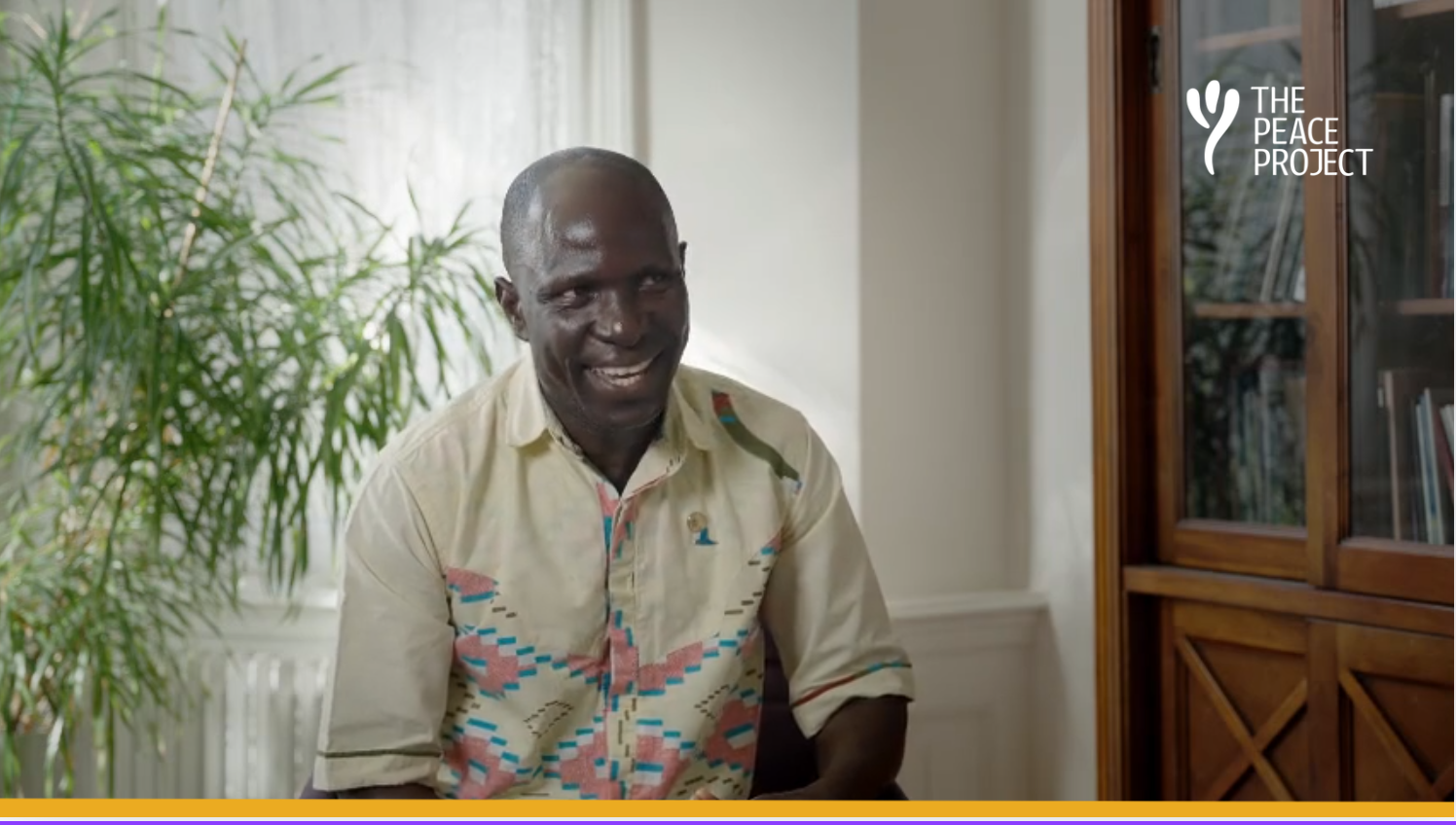
Patrick grew up in a conflict-affected community in eastern Uganda, where the sound of gunfire was a regular part of childhood. Today, as The Peace Project network coordinator for Uganda, he draws on that experience, and on a scholarship that changed his life, to support trauma healing and locally led peacebuilding across the country.
A childhood marked by conflict
Patrick is The Peace Project network coordinator for Uganda, a country he describes with visible pride as “the Pearl of Africa” for its beauty, though one still recovering from war, with violence continuing to spill over in the years that followed. He grew up in a humble, conflict-prone environment in eastern Uganda. “I grew up starting school but experiencing sounds of the bullet almost every day,” he says. “Sometimes you do not reach school because you have to run back.” Many of his childhood friends dropped out entirely, unable to go beyond primary school.
Poverty compounded the disruption of conflict. “Our parents were not able to pay our school fees or meet all the basics. Many times we would go hungry, without food to eat,” Patrick remembers. “We had to work together with my parents, doing simple cultivation, to be able to get the basics of life, to get food, but also to pay school fees.”
What changed his path was a moment of unexpected generosity: a friend stepped in to pay his tuition at a higher level of education. Later, Rotary International awarded him a peace scholarship to study in the United States. “I can say I’m among the lucky few who managed to come up,” he reflects. “That is why, even at the moment, I reflect back on my past and ask: how can I give back?”
“The worst thing I would always want to see in my life when I was a child was the bullet. So I always grew up asking myself: how can I be able to ensure, if I had all the powers in this world, that I silence all the guns and the bullets in this world?”
That question, carried from childhood, is what led Patrick to study conflict resolution and peacebuilding, and to co-found a community centre supporting youth and marginalised groups in his home region.
A fragile history, still shaping the present
Ask Patrick about the roots of conflict in Uganda, and he doesn’t stop at the most recent war. He traces it back further, to a complex, fragile history reaching as far as the colonial era. “We were probably intentionally divided up, and that was the beginning of so many divisions,” he explains. In his own home area, along the border with Kenya, families were split by the colonial demarcation line running through local rivers and swamps. “Some brothers ended up in Kenya, others ended up in Uganda… this created boundaries, artificial boundaries and unnecessary boundaries, and then it brought in tensions.”
Those divisions, he says, were reinforced by generations that followed.
“Later generations were also born and meant to believe that maybe their neighbours are enemies.”
Today, that history still shows up as ethnic conflict, land disputes, and cross-border tensions, including, more recently, tensions linked to the arrival of refugees from DR Congo and South Sudan.
The human cost is visible in places like northern Uganda, still living with the long aftermath of war. Patrick describes former child soldiers, some abducted “as early as maybe age ten,” some forced into unthinkable acts as part of their indoctrination. Many who return find their own families unable to accept them back. “Even their own parents would refuse to accept them,” he says. “None of them would say, yes, it’s my child… it causes even double trauma.” Without a clan to trace their origins to, since land and belonging in much of Uganda are organised by clan, some don’t even know how to establish who they are or where they come from.
Restoring hope, one person at a time
For Patrick, this is where the real work of peacebuilding begins, not with grand declarations, but with restoring hope in people who have lost it.
“At the end of the day, hope is the last thing you must not afford to lose. When someone loses hope, the next step can even be suicide.”
In practice, this starts with identifying trusted figures already embedded in communities. “Religious leaders, civil society, and other actors… who are kind of referral pathways when it comes to issues of trauma healing,” he explains. “We sit with them to engage them, to look at what is it that we can do.” Trainings are designed to cascade outward, so that the partners TPP works with, already trusted, already receiving people in crisis, can strengthen their own capacity to respond.
But the deepest transformation, Patrick says, happens peer to peer. “If I’m one of those who, in a group, was formerly affected, and I have been able to get the skills and transform myself, it becomes very easy to reach out to my friend, because there is already that high level of trust.” One person’s healing can ripple through ten others, and those ten through more. Groups of former abductees have gone on to organise themselves, sometimes starting small income-generating projects together.
“As they come together, they are learning together. They are sharing experiences. They are looking forward on how they can heal, that already is part of the healing.”
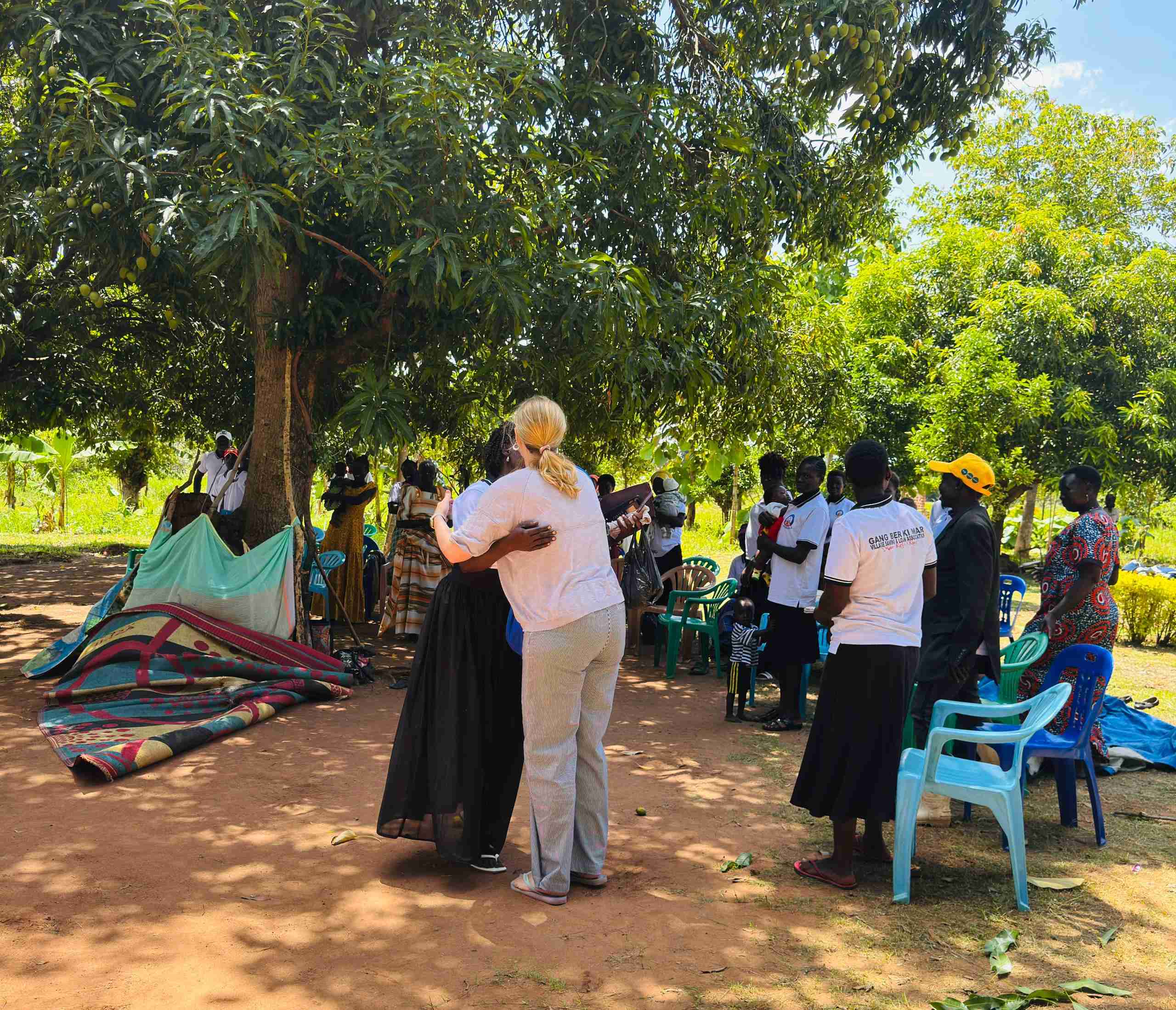
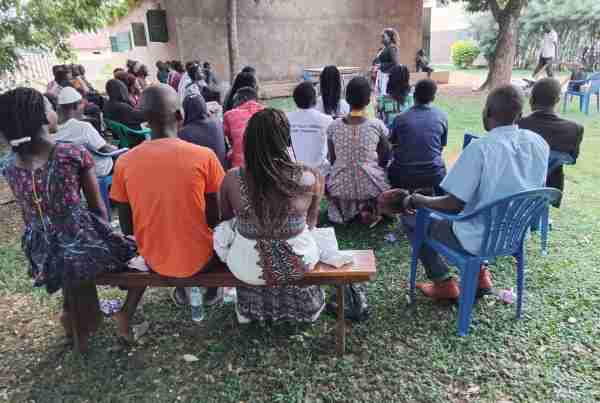
Nonviolent Communication (NVC) Refresher Workshop held in April 2026 at the Comboni Missionary Animation Center in Gulu, Uganda.
A vision for Uganda
When asked what he hopes The Peace Project will help achieve, Patrick describes something close to Shalom, “peace in totality.” He wants communities to move past ethnic divisions and
“start looking at ourselves beyond the ethnic lens, but also looking at ourselves as Ugandans, as humans, as people who have a common peace agenda.”
“I see coexistence. I see a good working relationship with each other. I see different ethnic tribes that have been fighting, working together towards a common goal of development. I see women, youth, and other marginalised groups feeling they are part of the process, part of the developmental agenda, part of the decision-making process. No one is feeling left behind.”
And, he adds, freedom “from want, and from need.”
It’s an ambitious vision, but Patrick has already lived through what change looks like once, through a scholarship, an education, and a decision to turn a childhood fear into a life’s purpose. Now, he’s working to help others do the same.